Power Out in One Room? What to Check First
When one room suddenly loses power but the rest of the house remains normal, the problem is usually limited to one electrical circuit.
A circuit breaker may have tripped because of an overloaded outlet, a faulty appliance or a short circuit. In other cases, a GFCI outlet, safety switch, wall switch or loose electrical connection may have interrupted power without making the cause obvious.
This guide explains the safe checks you can perform before calling a licensed electrician
Difficulty:
Easy diagnosis
Time:
10–30 min
Cost:
Usually $0
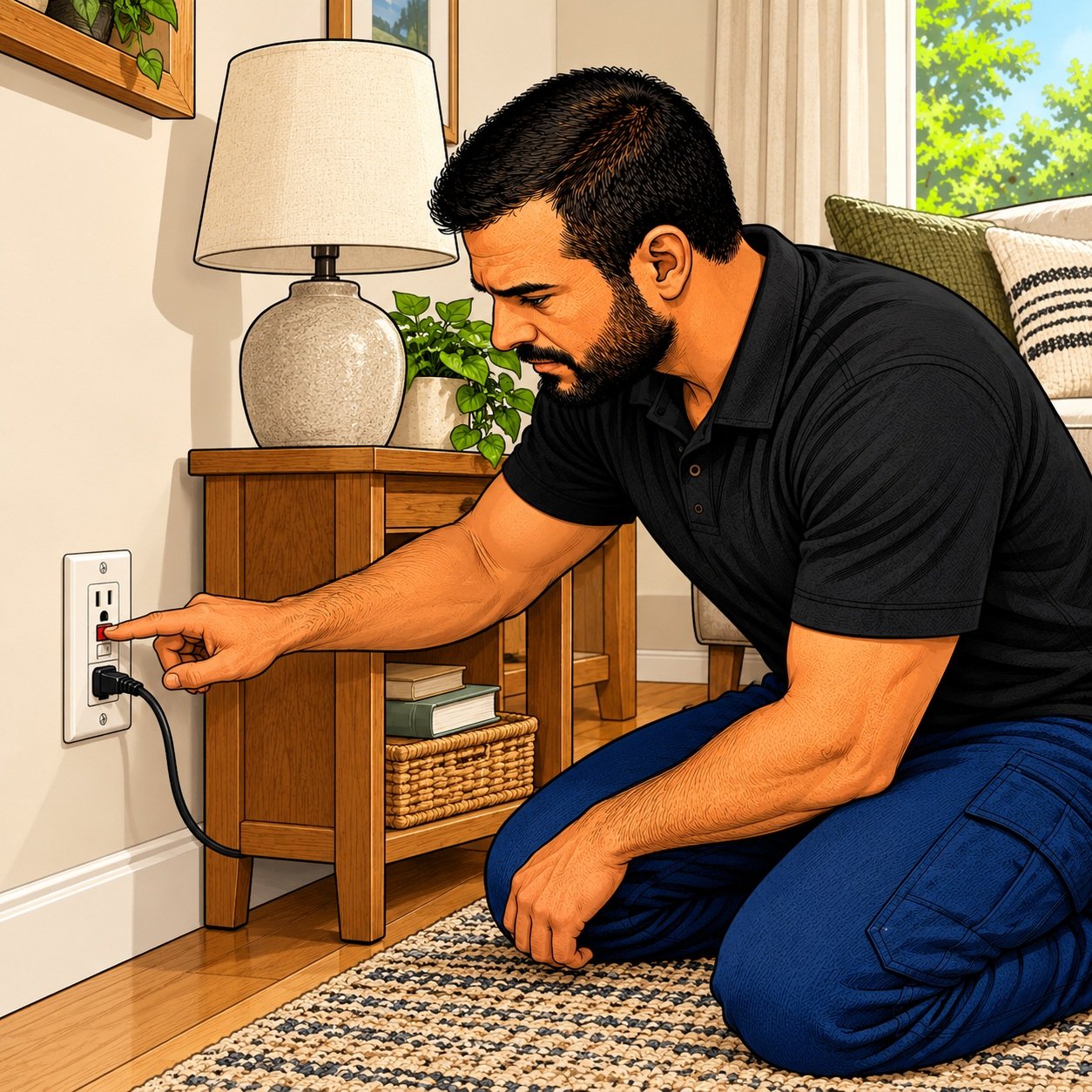
First: Confirm the Extent of the Power Loss
Before checking the electrical panel, determine exactly what has stopped working.
- Ceiling lights
- Table lamps
- Every wall outlet in the room
- Built-in appliances
- Adjacent rooms
- Hallway outlets
- Outdoor lights or outlets
- Bathrooms, kitchens and garages
- Heating or air-conditioning equipment
Use a small working lamp or another simple device to test outlets. Do not rely only on a phone charger, as its cable or adapter may be faulty.
- The whole room is without power.
- Only the lights are off.
- Only the outlets are off.
- One outlet is dead.
- Half the outlets are dead.
- Nearby rooms are also affected.
- Power failed when a particular appliance was switched on.
A room may be served by more than one circuit. Its lights may remain on while its outlets lose power, or the opposite may occur.
Check Whether It Is a Wider Power Outage
- Neighbours have power.
- Streetlights are operating.
- Other parts of your home have power.
- Your electricity meter is active.
- Your electricity provider has reported an outage.
If the entire house is without power, the problem may involve:
- A utility outage
- The main breaker
- A tripped safety switch
- The electricity meter
- The incoming supply
- A fault in the main electrical panel
If only one room or group of outlets is affected, continue with the checks below.
Step 1: Switch Off and Unplug Appliances
Before resetting anything, unplug devices from the affected room.
Pay particular attention to high-power appliances such as:
- Portable heaters
- Air conditioners
- Irons
- Hair dryers
- Vacuum cleaners
- Kettles
- Microwaves
- Refrigerators
- Power tools
- Dehumidifiers
- Extension leads
This reduces the electrical load and removes a potentially faulty appliance before power is restored.
The U.S. Consumer Product Safety Commission recommends investigating why a breaker has tripped instead of repeatedly resetting it. A tripped breaker can indicate an overloaded circuit, malfunctioning appliance, short circuit or another electrical fault.
Step 2: Check the Electrical Panel
Locate the circuit-breaker panel, fuse box or consumer unit.
It may be located in a:
- Garage
- Basement
- Utility room
- Hallway cupboard
- Exterior meter box
- Storage area
Use a flashlight if the area is dark. Do not use a candle.
Open only the normal hinged access door. Do not remove screws or take off the panel cover.
Look for a tripped breaker
A tripped breaker may not appear completely off. Its handle may sit:
- In the OFF position
- Between ON and OFF
- Slightly out of line with the other breakers
- In a position marked “TRIPPED”
Check the circuit labels, but do not assume they are accurate.
How to reset a breaker
After unplugging the devices in the affected area:
- Find the suspected tripped breaker.
- Move it fully to the OFF position.
- Pause for a few seconds.
- Move it firmly back to ON.
- Return to the room and check the lights and outlets.
A breaker must usually be moved fully off before it can be reset. Simply pushing a centre-positioned handle toward ON may not restore power.
The Electrical Safety Foundation International recommends unplugging or switching off appliances before moving a tripped breaker fully off and then back on.
If the breaker immediately trips again
Do not keep resetting it.
Leave the breaker off and contact an electrician. Immediate retripping may indicate:
- A short circuit
- A ground fault
- Damaged wiring
- A faulty outlet
- A defective appliance
- Water entering the circuit
Repeated resetting can increase the risk of overheating, fire or electrical injury.
Step 3: Look for a Tripped GFCI Outlet
If the breaker appears normal but the room still has no power, check for a tripped GFCI outlet.
A GFCI—also called an RCD outlet in some regions—has TEST and RESET buttons on its face. It shuts off electricity when it detects current leaking to ground.
One GFCI outlet can protect several ordinary-looking outlets located farther along the same circuit. The controlling GFCI may be in a different room.
Search for GFCIs in:
- Bathrooms
- Kitchens
- Garages
- Basements
- Laundry rooms
- Utility rooms
- Outdoor areas
- Near sinks
- Behind appliances
- Under kitchen counters
- Adjacent rooms
How to reset a GFCI
- Unplug devices from the dead outlets.
- Make sure your hands and the outlet are dry.
- Press the RESET button firmly.
- Listen or feel for a click.
- Test the affected outlets with a working lamp.
- No incoming power
- A ground fault
- Moisture
- A faulty appliance
- A damaged GFCI
- A wiring problem
The Electrical Safety Foundation International advises replacing a GFCI if its test or reset functions do not work. Replacement should be completed by a qualified person.
Step 4: Check the RCD or Safety Switch
Some homes have an RCD or safety switch inside the electrical panel that protects one or more circuits.
A safety switch is different from an ordinary circuit breaker:
- A circuit breaker protects wiring against excessive current.
- An RCD or safety switch helps protect people from electrical shock caused by current leakage.
If it has tripped:
- Unplug appliances on the affected circuit.
- Move the switch fully off if required.
- Reset it to the on position.
- Check whether power returns.
If it will not reset, or it trips again when an appliance is connected, stop and contact an electrician.
Electrical Safety Queensland advises calling an electrician when a safety switch or breaker trips regularly or the cause cannot be safely identified.
Step 5: Check Wall Switches
Some outlets are controlled by wall switches.
This is common in:
- Bedrooms
- Living rooms
- Hotel-style rooms
- Older homes
- Rooms designed for table lamps
- Outdoor areas
Check all wall switches in and immediately outside the affected room.
A switched outlet may look like a normal outlet, and sometimes only one half of a duplex outlet is controlled by the switch.
Also inspect smart switches or wireless controls. A smart switch may stop operating because:
- It lost mains power.
- Its internal electronics failed.
- Its companion switch is offline.
- The system needs to restart after an outage.
Do not remove a switch plate or touch the wiring.
Step 6: Check Whether One Appliance Caused the Trip
- Leave high-power appliances unplugged initially.
- Plug in one device.
- Switch it on.
- Wait briefly.
- Continue with the next device.
If the breaker or GFCI trips when one particular device is connected, unplug that device and stop using it.
The appliance may have:
- A damaged power cord
- An internal short circuit
- Moisture damage
- A faulty heating element
- Current leaking to ground
- A damaged plug
- A failing motor
Do not repeatedly reconnect a suspected faulty appliance. Have it repaired or replaced
Step 7: Consider an Overloaded Circuit
This commonly happens when several high-power appliances operate together, such as:
- A portable heater and vacuum cleaner
- An iron and hair dryer
- A microwave and kettle
- Multiple power tools
- Several appliances connected through an extension lead
Signs of an overloaded circuit include:
- Breaker tripping after several devices start
- Lights dimming when appliances operate
- Warm plugs or outlets
- Buzzing
- Discoloured extension leads
- Power returning after some devices are unplugged
Reduce the load by moving appliances to separate properly rated circuits.
Do not:
- Replace the breaker with a higher-rated one
- Install a larger fuse
- Use multiple extension leads to distribute the same load
- Connect one power strip to another
- Bypass the breaker or safety device
A breaker rating must match the circuit wiring. Increasing it without replacing and redesigning the circuit can allow wiring to overheat.
Step 8: Check for a Blown Fuse
A blown fuse must be replaced with:
- The same type
- The correct voltage rating
- The same current or amperage rating
Never replace a fuse with one of a higher rating. Never bypass a fuse with wire, foil or another metal object.
If you are uncertain about the fuse type or the reason it failed, contact an electrician.
Repeatedly blown fuses indicate an overload or electrical fault that needs investigation.
Step 9: Inspect Outlets Without Taking Them Apart
Look for:
- Scorch marks
- Melted plastic
- Cracks
- Loose outlet faces
- Brown or black discolouration
- Water or condensation
- A burnt smell
- Plugs that no longer fit securely
Do not touch or continue using an outlet that is:
- Hot
- Buzzing
- Crackling
- Sparking
- Smoking
- Giving electric shocks
Electrical Safety First recommends prompt professional inspection when outlets show burn marks, feel hot, produce arcing sounds or are associated with repeated breaker trips.
Leave the circuit off and contact an electrician.
What If the Breaker Is Not Tripped?
Possible causes include:
- A tripped GFCI located elsewhere
- A failed GFCI outlet
- A loose outlet connection
- A failed wall switch
- A damaged wire
- A faulty circuit breaker
- A loose connection inside a junction box
- A failed outlet interrupting power to downstream outlets
- A problem with an AFCI breaker
- A wiring connection damaged by heat
Electricity can pass from one outlet to the next. If an upstream connection fails, every outlet after it may lose power while the breaker remains on.
Locating that failure requires electrical testing. Do not remove outlets from the wall or test exposed wires yourself.
What If Only the Lights Are Out?
- The light bulbs
- Wall switches
- Dimmer switches
- Smart-light controls
- The lighting circuit breaker
- A lighting-specific RCD
- Any ceiling fan controls
Try a known working bulb with the correct fitting and wattage.
If several lights fail simultaneously, the problem is unlikely to be multiple burned-out bulbs. It may involve a switch, lighting circuit or loose connection.
What If Half the House Loses Power?
Possible causes include:
- Loss of one incoming supply leg
- A service connection problem
- A damaged main breaker
- A utility supply fault
- A loose neutral or service conductor
You may notice:
- Some lights working while others do not
- Major appliances failing
- Lights becoming unusually bright or dim
- Power varying between rooms
- Buzzing near the main panel
- Flickering throughout the home
Switch off sensitive electronics and contact your electricity provider or a licensed electrician immediately.
Do not open the main panel or meter equipment.
What If Only the Outlets Are Out?
- Unplug all appliances.
- Check the outlet circuit breaker.
- Search for a tripped GFCI.
- Check wall switches controlling outlets.
- Test multiple outlets with a working lamp.
If some outlets work and others do not, a failed upstream outlet or loose connection may have interrupted power to the remaining outlets.
An electrician should inspect the circuit.
How to Prevent Future Circuit Trips
- Avoid running several high-power appliances on one circuit.
- Do not connect extension leads to other extension leads.
- Replace damaged plugs and cables.
- Keep outdoor outlets properly covered.
- Keep electrical equipment away from water.
- Test GFCIs and safety switches regularly.
- Stop using appliances that repeatedly trip protection.
- Label breakers accurately.
- Have loose or damaged outlets repaired promptly.
- Consider adding dedicated circuits for high-power appliances.
- Arrange an electrical inspection in older homes.
Frequently asked questions
Why is there no power in one room but the breaker is not tripped?
A GFCI may have tripped elsewhere, a wall switch may control the outlets or an upstream outlet or wiring connection may have failed. If resetting the relevant GFCI does not restore power, contact an electrician.
Is it safe to reset a tripped breaker?
It is generally reasonable to reset it once after unplugging the appliances on that circuit. If it immediately trips again, leave it off and have the fault investigated.
Why does the breaker trip whenever I plug something in?
The appliance may be faulty, or the circuit may already be overloaded. Stop using the appliance if the breaker consistently trips when it is connected.
Can a GFCI in another room cut power to my outlets?
Yes. One GFCI can protect several downstream outlets, sometimes in different rooms or outdoor areas.
Why are only some outlets in the room working?
The room may be supplied by multiple circuits, one outlet may be switch-controlled or an upstream connection may have failed.
Can I replace the breaker with a larger one?
No. The breaker must be sized for the circuit wiring. Installing a larger breaker can allow the wires to overheat and create a fire risk.
Should I remove the outlet to check the wires?
No. Loose or damaged wiring must be tested with the circuit safely isolated and should be handled by a licensed electrician.
Related Posts