Water Heater Not Working? DIY Troubleshooting Guide
Turning on the shower and getting cold water does not always mean your water heater needs replacing. An interrupted power supply, an incorrect operating mode, or a tank that has run out of hot water could explain the problem.
The first step is to find out what has changed. Is every hot tap cold? Does the water start hot and quickly cool down? Is the heater showing an error code?
This guide covers practical checks for electric, gas, tankless, and heat pump water heaters, along with the warning signs that mean you should stop troubleshooting and arrange professional help.
Difficulty:
Moderate
Time:
20–45 min
Cost:
$0–$40
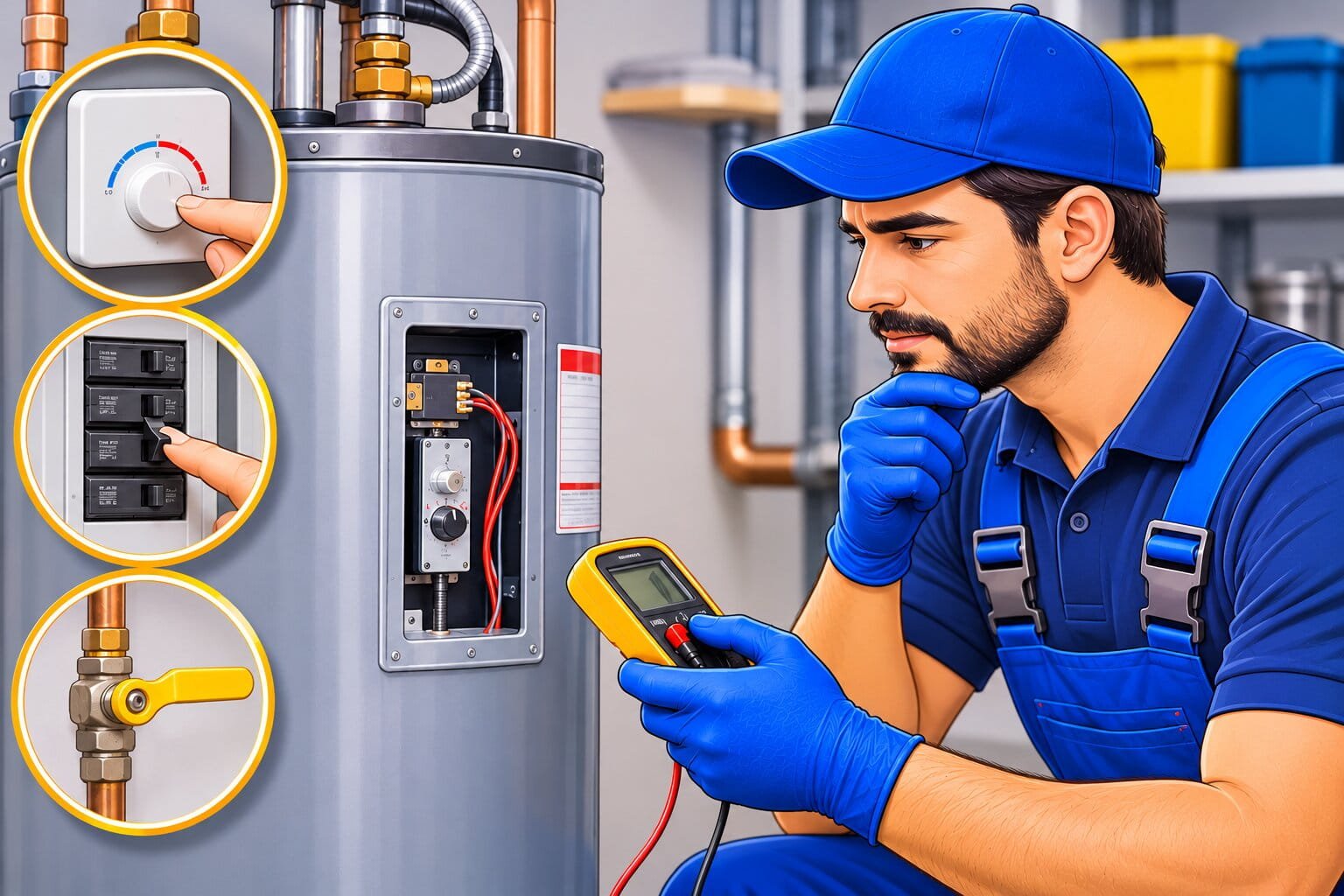
Before You Start: Check for Immediate Hazards
Water heaters combine hot water, pressure, and an energy source. Keep your initial checks outside the appliance casing.
Stop troubleshooting if you notice any of these problems:
- A gas smell or sound of escaping gas
- A carbon monoxide alarm
- Smoke, sparks, burning smells, or scorched wiring
- Water around electrical equipment
- Steam, boiling sounds, or unexpectedly scalding water
- A major leak or damaged tank
If you suspect a gas leak, leave the building without operating electrical switches, using a phone inside, or attempting to light anything. Contact the gas emergency service from outside. US consumer safety guidance recommends leaving immediately when gas is smelled or heard leaking.
If a carbon monoxide alarm sounds, get everyone into fresh air and contact emergency services. Carbon monoxide has no smell, so a lack of gas odor does not rule it out.
Never plug a relief-valve discharge pipe or bypass a safety control to make the heater run.
Start Here: Identify the Symptom
Test more than one hot-water fixture before blaming the heater.
- One shower or faucet stays cold: Local cartridge, mixing valve, or supply restriction.
- Every hot tap stays cold: Heater power, fuel, controls, or a system fault.
- Water starts hot but quickly turns cold: Stored supply exhausted, operating mode, or a heating fault.
- Hot water is available but flow is weak: A restriction in the hot-water plumbing.
- Water temperature changes repeatedly: Demand, mixing controls, or a heater fault.
- The display shows an error: Model-specific troubleshooting instructions.
- Water collects beneath the heater: Connections, condensate drainage, valves, or the tank.
Tools and supplies
- Flashlight
- Phone or camera
- Model and serial number
- Notes about when the fault began
- Owner’s manual
- A suitable thermometer, if checking outlet temperature safely
Photograph any error code before changing settings or restarting the appliance.
You do not need to remove electrical covers, disconnect gas fittings, or open pressure components for the checks below.
If you rent or have a rented water heater, contact the landlord, property manager, or rental provider before arranging repairs.
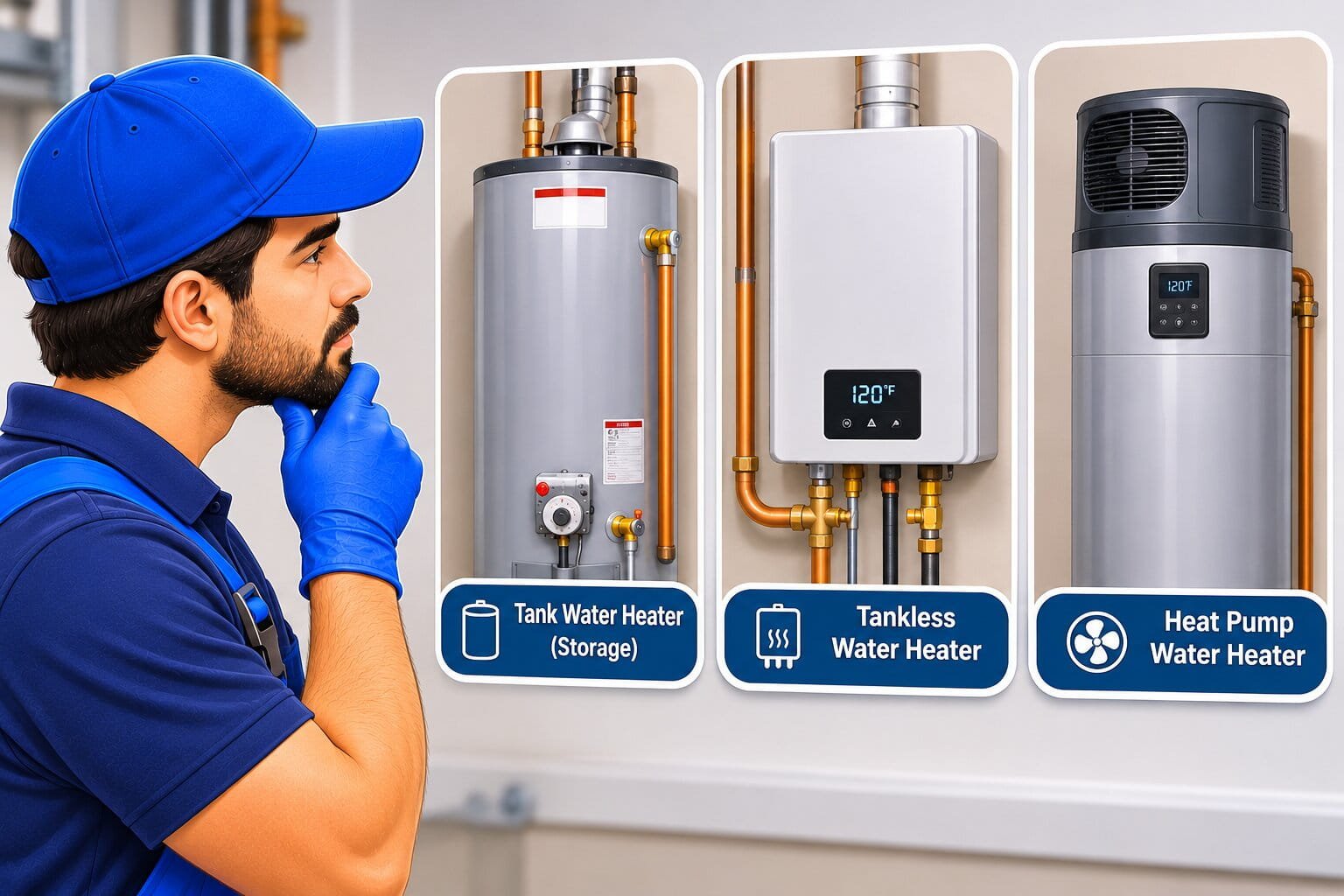
1. Identify Your Water Heater Type
Read the appliance label rather than guessing from its appearance.
Common systems include:
- Electric storage: Heats water in a tank using electric elements.
- Gas storage: Uses a gas burner to heat stored water.
- Tankless or instantaneous: Heats flowing water when there is sufficient demand.
- Heat pump: Transfers heat from surrounding air into stored water, sometimes with backup elements.
- Solar-assisted: Uses solar energy with a gas or electric booster.
“Tankless” describes how water is heated, not its fuel. Tankless heaters may use gas or electricity.
Once you know the type, follow the relevant checks instead of trying every procedure.
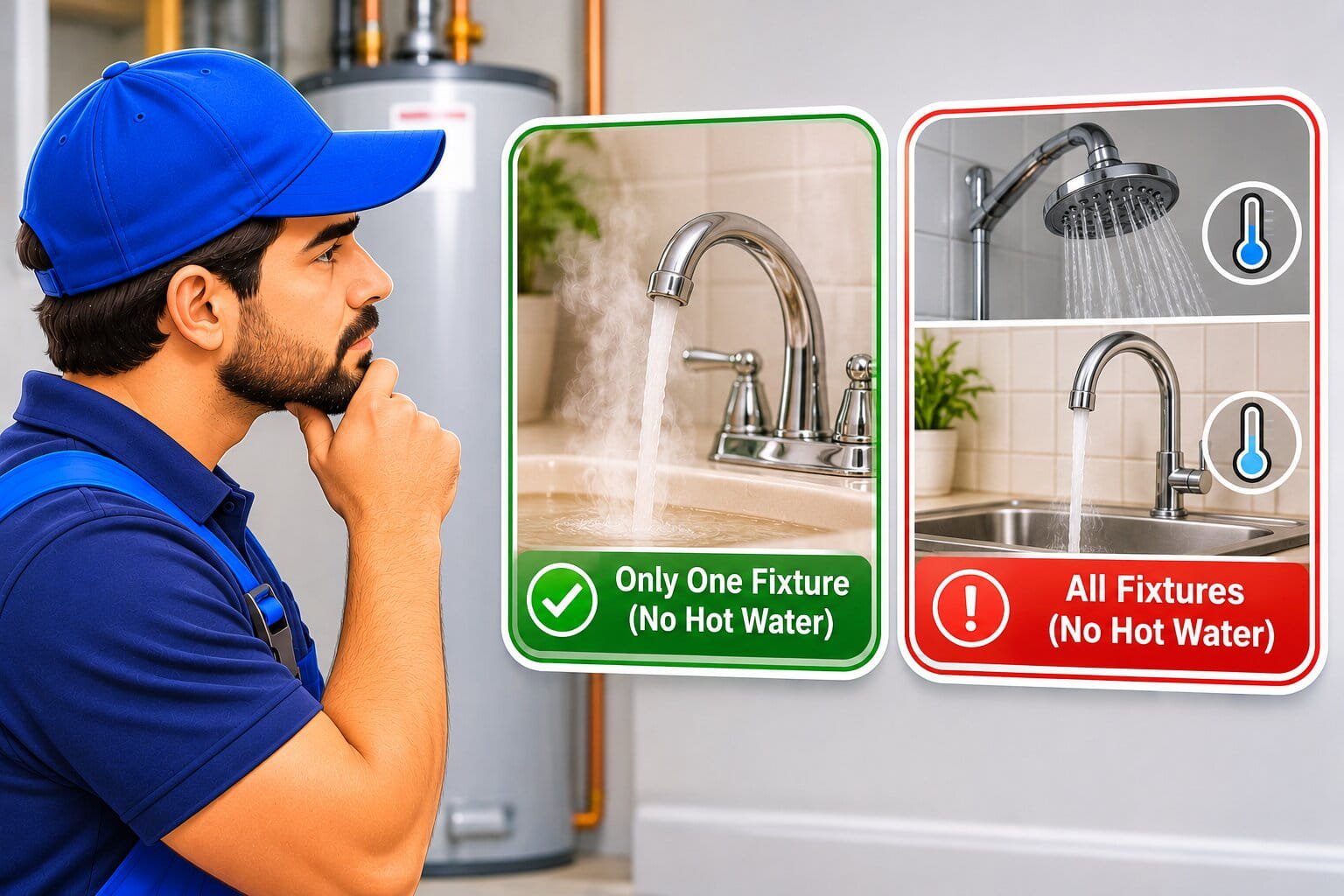
2. Check Whether the Problem Affects the Whole Home
Run a hot tap at another sink, taking care to avoid scalding if hot water returns suddenly.
If other fixtures get hot normally, investigate the affected fixture first. A shower mixing cartridge or local restriction can prevent hot water from reaching one outlet even when the heater is working.
If the hot side has weak flow throughout the home, the issue may be a restriction rather than a failure to heat.
If both hot and cold water have stopped, check the incoming water supply. Do not continue operating equipment that has lost its required water supply.
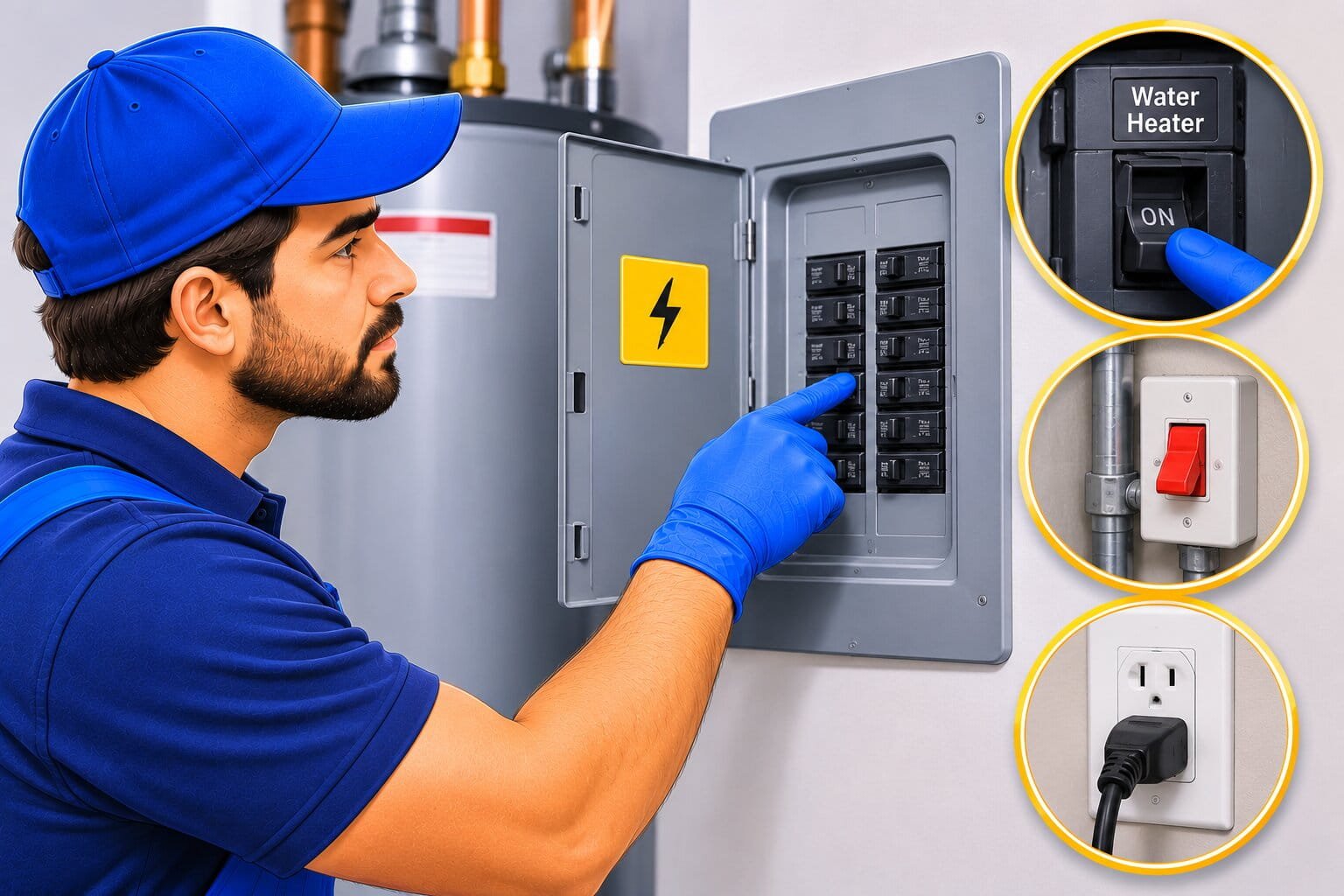
3. Check the Power Supply
Electric Storage Water Heaters
Look for an outage, an intentionally switched-off supply, or a tripped breaker.
If the heater’s breaker has tripped:
- Check for leaks, burning smells, heat damage, or other warning signs.
- Leave it off if any are present.
- If the panel is dry and undamaged, follow the owner’s manual and breaker instructions.
- Where permitted by those instructions, reset the breaker once.
- If it trips again, leave it off and arrange service.
Do not repeatedly reset a breaker. A recurring trip needs diagnosis.
A.O. Smith identifies electrical supply problems and tripped breakers among the possible causes of no hot water.
Gas and Tankless Water Heaters
Some gas models also need electricity for ignition, controls, or a fan. A blank display after a power outage may therefore affect a gas appliance too.
Check only accessible switches, plugs, and user controls described in the manual. Do not open wiring compartments.
Off-Peak or Controlled-Load Systems
Some storage heaters operate on scheduled electricity supplies. If the tank has been emptied, it may not reheat until the next heating period.
Check your tariff arrangement, timer, and any approved boost function before assuming a component has failed.
4. Check Operating Modes and Schedules
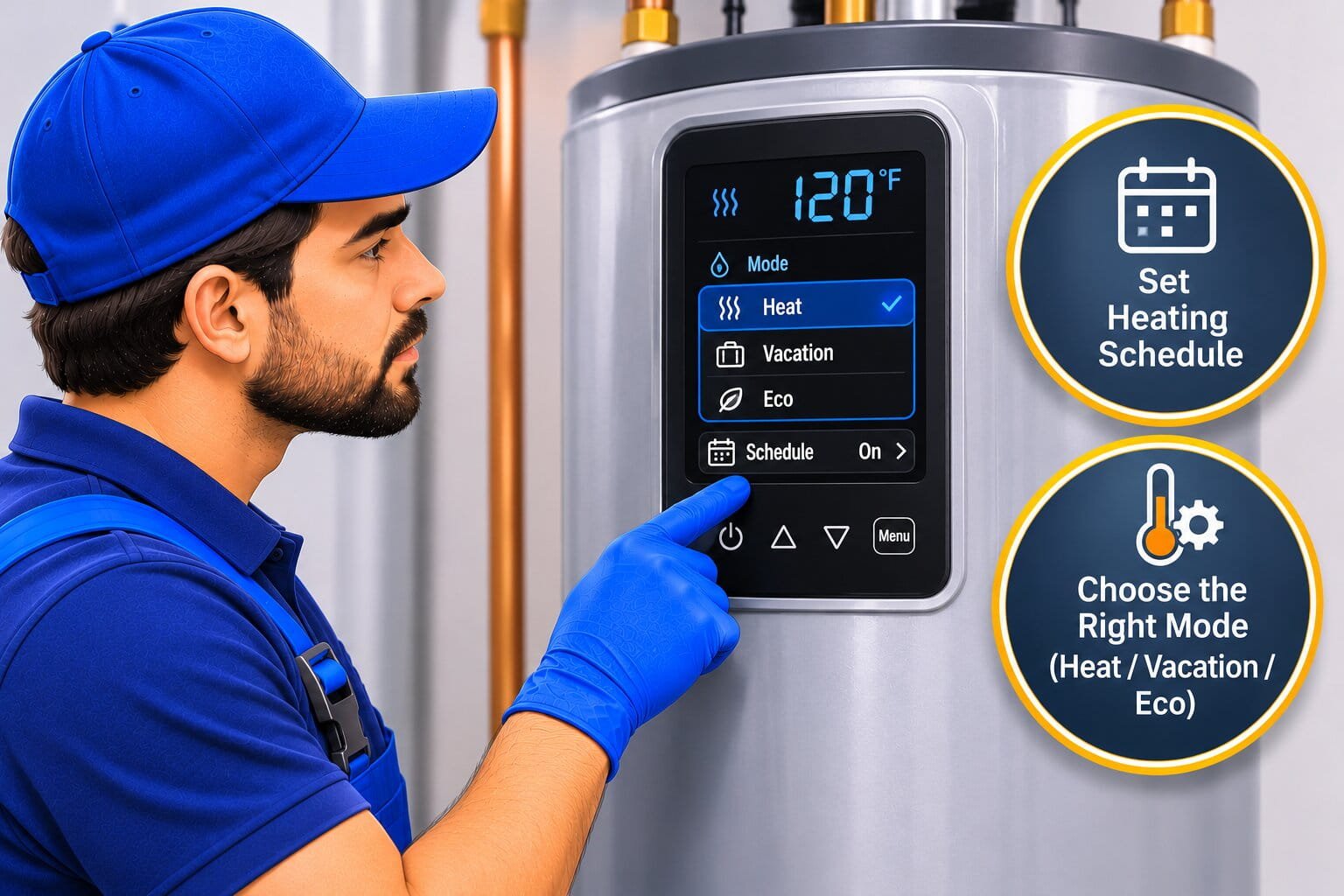
Look at the user-accessible display or controller.
Check for:
- Vacation or holiday mode
- A heating schedule that does not match your routine
- A recently changed setting
- A disabled booster
- A remote-control or app schedule
- A mode intended to reduce energy use
Heat pump systems may offer economy, hybrid, and higher-demand modes. Their recovery performance can differ, so use the mode descriptions for your model.
ENERGY STAR notes that some heat pump water heaters include efficiency, vacation, and timer settings.
Do not turn up the temperature simply to hide a heating problem. First confirm that the heater is actually operating.
5. Allow a Storage Tank to Recover
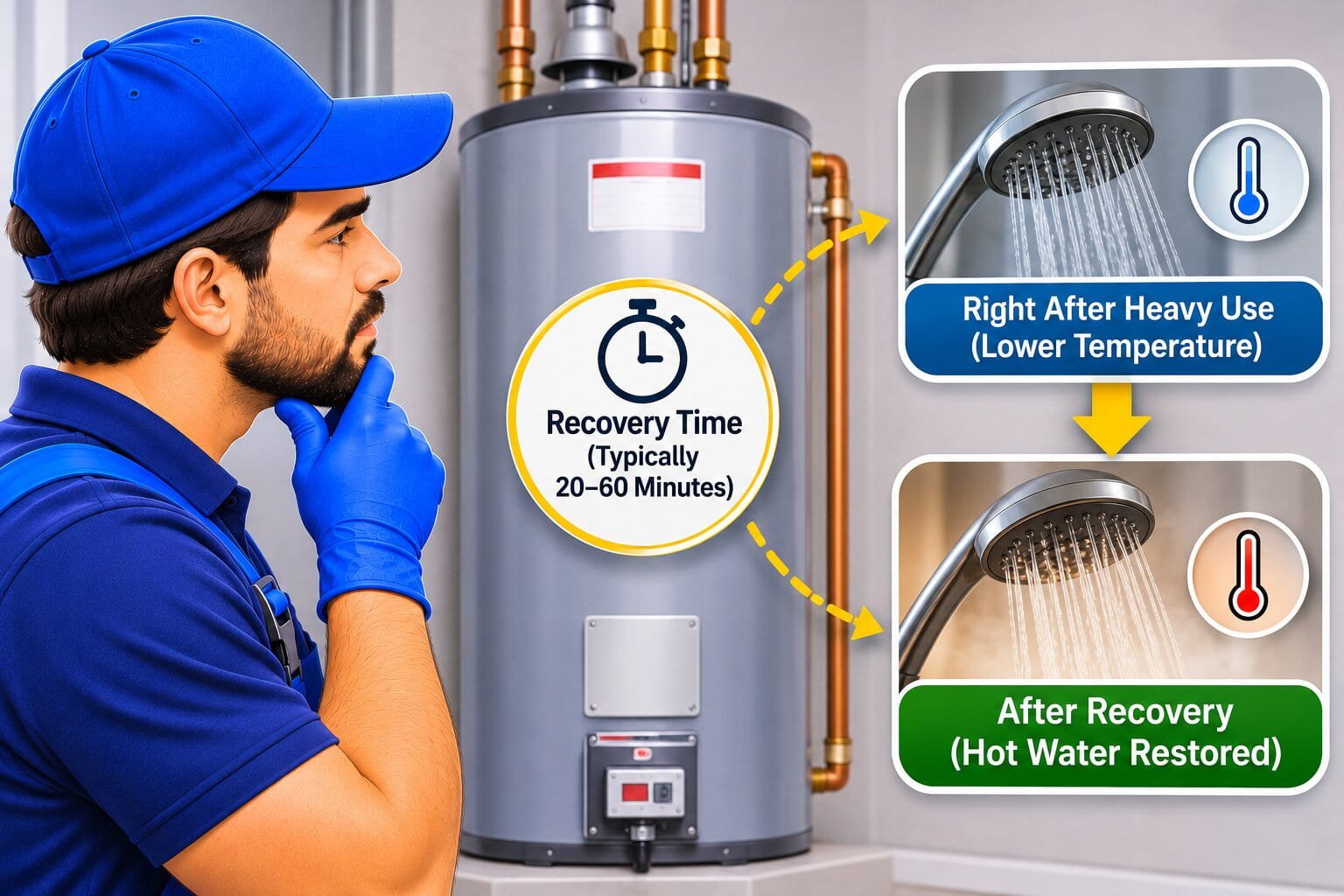
Back-to-back showers, baths, and appliance use can exhaust the available hot water.
To check:
- Stop using hot water temporarily.
- Confirm that the heater is in its normal heating mode.
- Allow the recovery time specified for the model.
- Test one outlet carefully.
There is no single recovery time for every heater. Tank size, heating capacity, inlet temperature, operating mode, and electricity scheduling all matter.
Heat pump systems can take longer to reheat than some conventional systems, particularly under certain operating conditions. NSW Government guidance highlights this difference for household heat pump water heaters.
If the same household routine suddenly produces much less hot water than before, arrange an assessment rather than accepting it as normal.
6. Check Gas Heater Status and Pilot Instructions
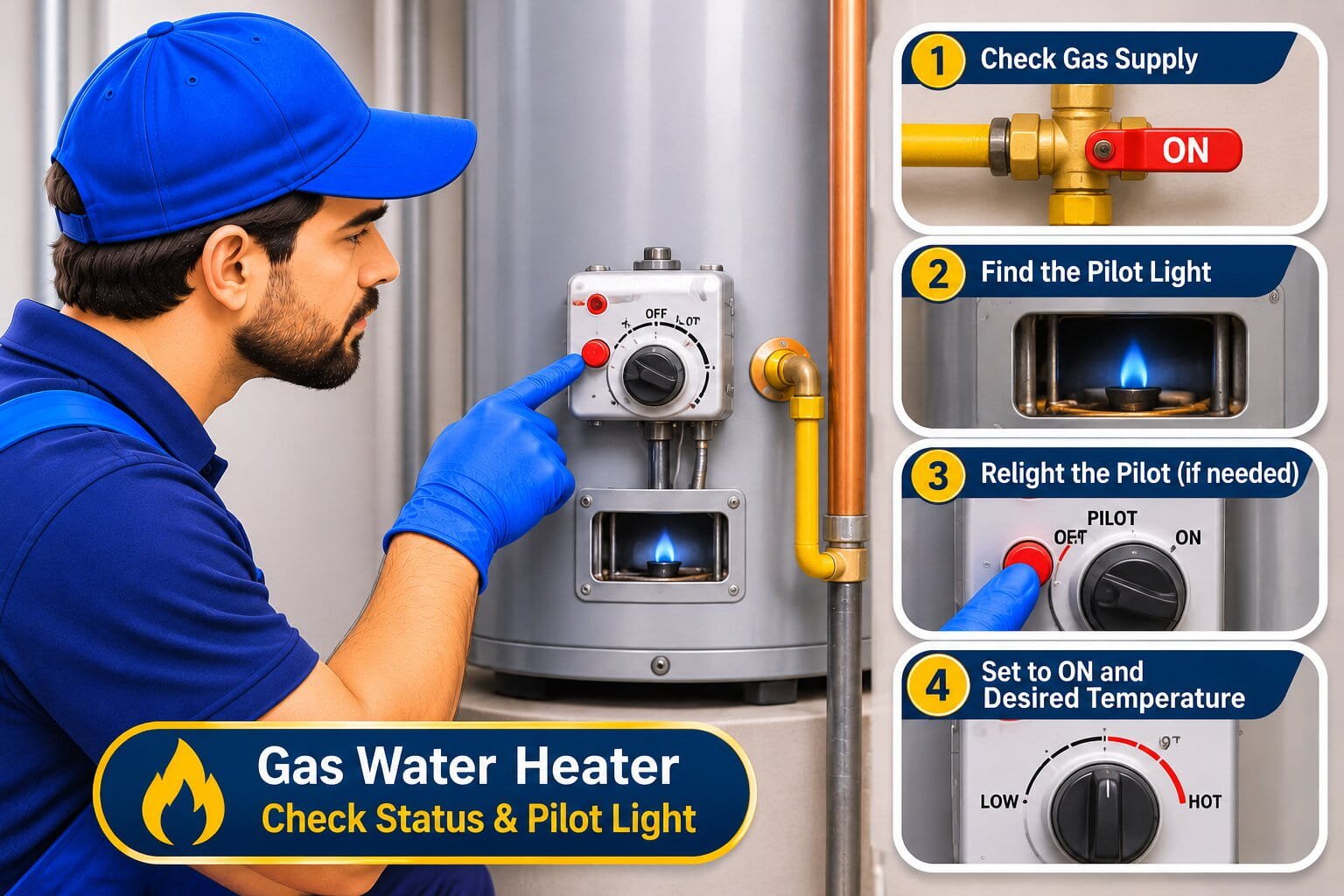
For a gas heater, observe the external status display or indicator through the intended viewing area.
Check for a known gas supply interruption and record any flashing-light pattern.
Some older models have a standing pilot. Others use automatic ignition and should not be manually lit.
Only attempt pilot relighting if:
- The manufacturer provides a homeowner procedure.
- There is no gas smell or other warning sign.
- The appliance has not been flooded or damaged.
- You can follow the exact instructions on the heater.
Follow all specified waiting periods and stop conditions. Do not use a generic lighting sequence from a different model.
Rheem provides separate relighting instructions for different gas hot-water products, reinforcing the need to identify the actual appliance.
If a pilot will not stay lit or repeatedly goes out, stop relighting it and arrange service. Do not adjust gas valves, burners, or flame-safety components.
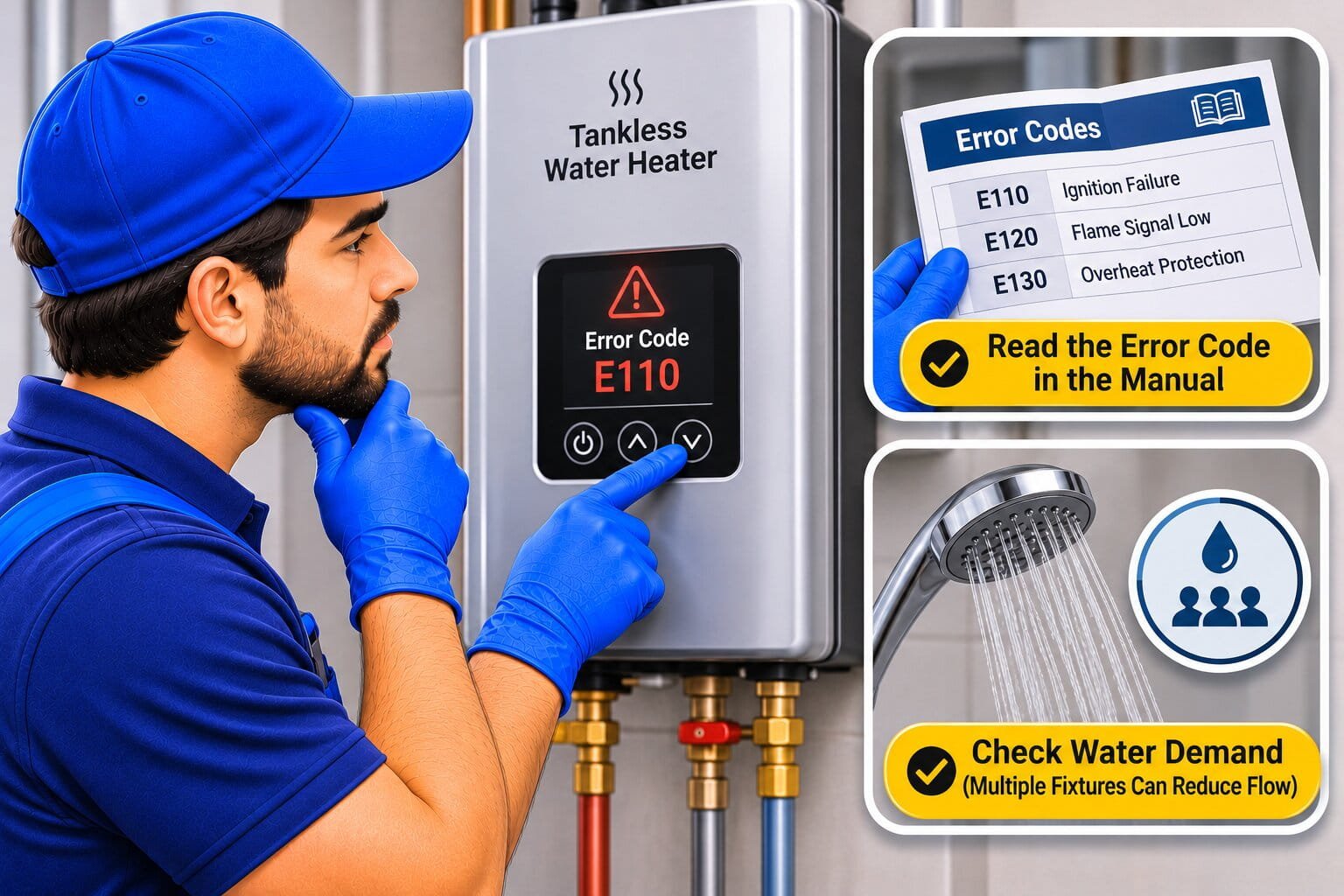
7. Read Tankless Error Codes and Check Demand
If a tankless heater has power but does not heat, photograph its display while a hot tap is running.
Look up the code in the correct owner’s manual. The same number can mean different things across brands and models.
For basic checks:
- Confirm that the controller is on.
- Check whether the problem affects more than one fixture.
- Try one hot-water outlet with sufficient flow, taking care around suddenly hot water.
- Check accessible faucet aerators or showerheads for restricted flow.
- Reduce simultaneous hot-water use and compare performance.
Tankless heaters need a minimum flow to activate. Several outlets running together can also exceed the unit’s heating capacity under the current conditions.
Rinnai’s troubleshooting documentation includes water-flow issues among the possible causes of a no-hot-water condition without an error code.
Only clean an inlet filter if the manual explicitly describes it as homeowner maintenance and you can follow the isolation and depressurization procedure.
Avoid repeated restarts to clear a recurring code. Record it and arrange service.
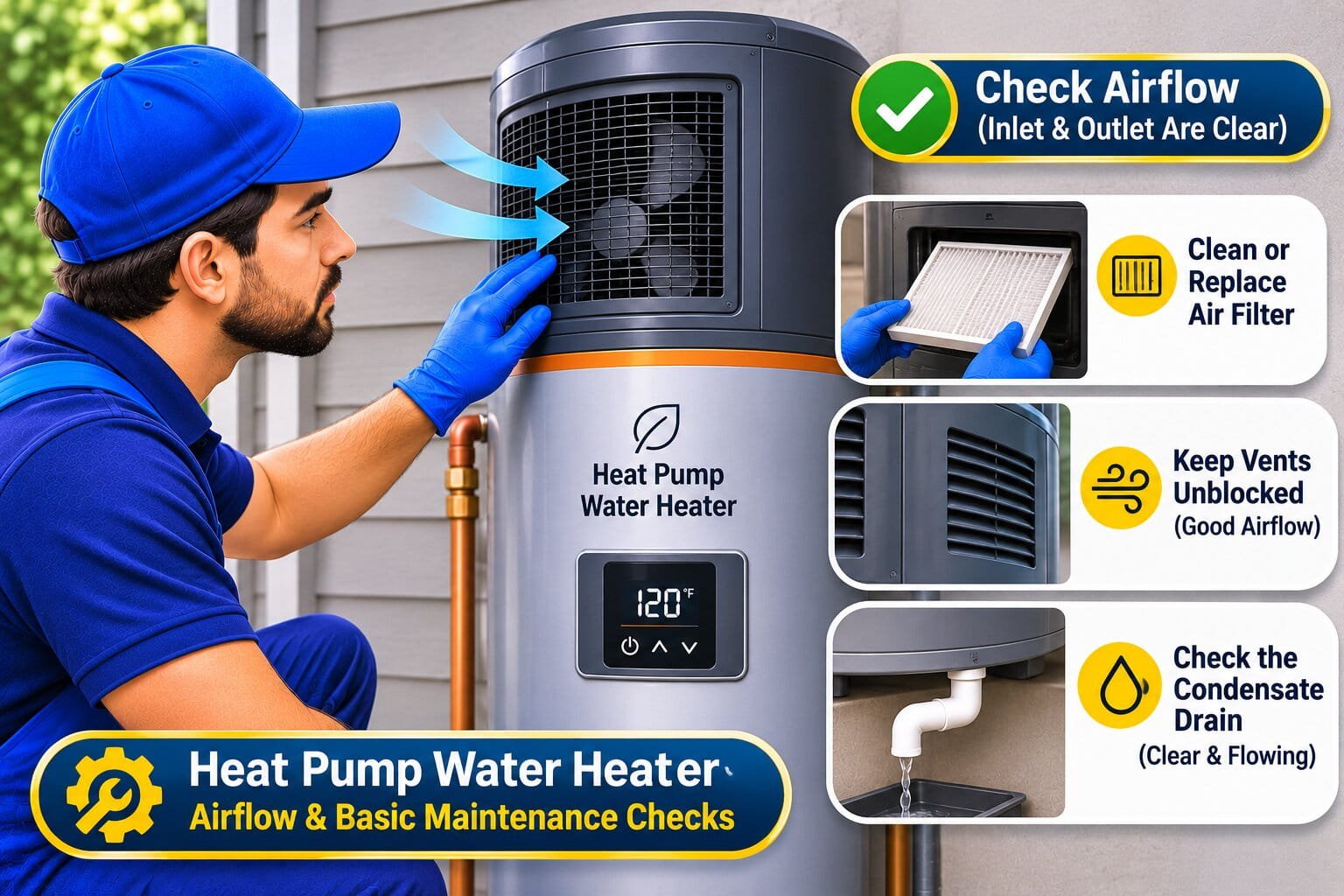
8. Check Heat Pump Airflow and Accessible Maintenance Items
A heat pump heater needs the airflow and surrounding conditions specified by its manufacturer.
Check that stored items have not blocked its air inlet or outlet.
If the model has a homeowner-serviceable air filter:
- Follow the shutdown instructions.
- Remove the filter as directed.
- Clean it using the specified method.
- Allow it to dry if required.
- Reinstall it before restarting.
Do not remove service panels or work on the fan, compressor, refrigerant system, or wiring.
Rheem identifies filter maintenance as part of heat pump care and recommends professional attention for electrical checks and other service tasks.
Also note whether water appears around the condensate drain. A blocked condensate path needs attention, but do not assume every puddle is harmless condensation.
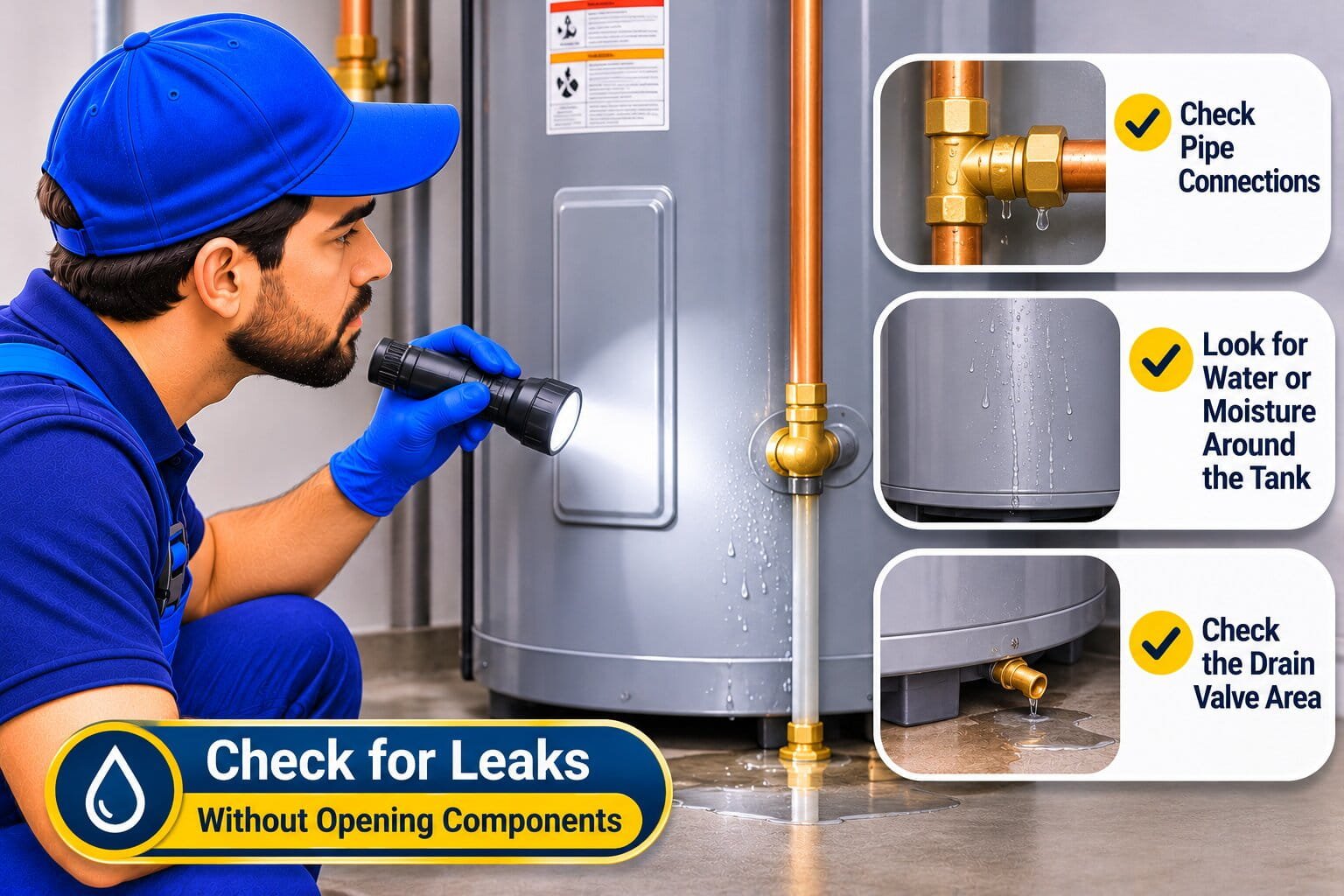
9. Check for Leaks Without Opening Components
Use a flashlight to inspect accessible connections and the surrounding floor.
Water may come from a pipe connection, condensate drain, relief discharge, or the tank itself. Its position on the floor does not always identify the source.
Never cap, plug, or close off a temperature-and-pressure relief discharge. Rheem explicitly warns against plugging the relief-valve outlet.
Some systems discharge a limited amount of expansion water during heating, depending on their design. Continuous discharge, a heavy flow, or a sudden change requires assessment.
For a substantial leak, stop using the system and follow the manufacturer’s emergency shutdown instructions if you can do so safely. Do not approach electrical controls through standing water.
Should You Press the Water Heater Reset Button?
If reaching it requires removing an electrical access cover, leave that step to a qualified technician. The cause of the trip may involve overheating, a thermostat, an element, or wiring.
A user-accessible restart described in the manual is different. Follow its instructions, but do not repeatedly reset a fault that returns.
What Temperature Should a Water Heater Be Set To?
Guidance also differs by country:
- United States: Department of Energy guidance commonly recommends 120°F, approximately 49°C, for most residential applications.
- Canada: Public-health guidance recommends 60°C storage to control harmful bacteria, with mixing valves limiting delivery to approximately 49°C.
- Australia: Government guidance commonly recommends 60°C for storage systems, with delivery-temperature controls to reduce scalding risk.
Follow local requirements, the system’s design, and professional advice. Do not apply a storage-heater setting blindly to a different system or adjust a tempering valve yourself
Common Mistakes to Avoid
- Assuming one cold shower means the heater has failed: Test another fixture.
- Repeatedly resetting a breaker or safety device: Investigate the recurring fault.
- Opening electrical covers: External checks do not require access to live components.
- Relighting the wrong type of gas heater: Use model-specific instructions.
- Turning the temperature up without diagnosis: This can introduce a scalding risk.
- Draining a tank without a procedure: Re-energizing an empty electric tank can damage elements.
- Ignoring leaks or relief discharge: Identify the cause before continued use.
Keep Your Water Heater Working Reliably
- Follow the manufacturer’s maintenance schedule and keep the model details accessible.
- Maintain required clearances, clean serviceable filters, and check for leaks or error messages. Have fuel-burning appliances serviced appropriately and maintain carbon monoxide alarms according to local guidance.
- Tank flushing, descaling, anode inspection, and safety-valve checks depend on the system. Arrange them according to the manual rather than applying one maintenance routine to every heater.
Frequently asked questions
Why is my water heater on but the water is cold?
Power at the display does not prove the heating components are working. Check modes, schedules, demand, and error codes before arranging service.
Why does my hot water run out faster than before?
Increased use, colder incoming water, changed settings, or a heating fault can reduce the usable supply. A sudden change under the same conditions deserves investigation.
Why does only one shower stay cold?
A local cartridge, mixing valve, or supply issue may be responsible. Test other hot-water fixtures first.
Should I flush the heater if there is no hot water?
Not as a first diagnostic step. Confirm the supply, controls, and symptoms first. Flushing does not repair an electrical or ignition fault and introduces hot-water and draining hazards.
Can I repair a heating element myself?
Element replacement involves electrical isolation, testing, and water-system work. Use a qualified professional as required locally.
Does no hot water mean I need a replacement?
No. Controls, supply problems, and serviceable components may explain the fault. A leaking tank or major damage may lead to a replacement recommendation after assessment.
Related Posts